


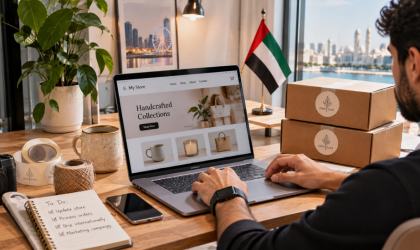

Starting an online store no longer means investing in a physical shop, hiring a large team or managing expensive retail premises. With Shopify, entrepreneurs can build an e-commerce business, reach customers across the UAE and sell internationally from a single platform.
However, creating a Shopify website is only part of the process.
Before accepting your first order, you need to understand the UAE’s business licensing requirements, choose a payment gateway, arrange delivery services and determine whether VAT registration applies.
The good news is that you do not need to establish your company in Dubai to run a Shopify business. Entrepreneurs can also establish an e-commerce company through Sharjah-based free zones such as Shams Free Zone.
This guide explains how to start a Shopify store in the UAE, from obtaining the right business licence to setting up payments, managing deliveries and making your first sale.
Do You Need a Licence to Sell on Shopify?
Yes. If you are operating a Shopify store as a commercial business in the UAE, you generally need an appropriate trade licence.
Shopify provides the technology to create and manage an online store, but it does not issue business licences or replace local regulatory requirements.
For example, you may need a licence if you plan to:
- Sell clothing, accessories, electronics or beauty products.
- Operate a dropshipping business.
- Sell products under your own brand.
- Import products and sell them through Shopify.
- Run an online retail business from home.
- Sell digital products or services commercially.
The licence activity should match what your business actually does.
An entrepreneur selling physical consumer products may need an e-commerce or trading activity, while someone selling digital services may require a different activity.
Certain products, including food, cosmetics, medical products and regulated goods, may also require additional approvals before they can be sold.
Can you create a Shopify store before getting a licence?
You can generally explore Shopify, design your website and prepare product listings before launching your business.
However, you should obtain the necessary business authorisation before beginning commercial operations.
Payment providers may also request your trade licence, business registration details and banking information before activating payment processing.
This makes business licensing an important early step in setting up a Shopify store in the UAE.
The Free Zone E-Commerce Licence Route
One of the first decisions when starting a Shopify business is where to register your company.
In the UAE, entrepreneurs commonly choose between mainland business registration and free zone company formation.
Both routes can support e-commerce businesses, but their licensing conditions and operational requirements differ.
Mainland vs free zone for Shopify sellers
| Feature | Mainland company | Free zone company |
|---|---|---|
| Licensing authority | Relevant emirate’s economic department | Selected free zone authority |
| Foreign ownership | 100% available for many activities | 100% foreign ownership generally available |
| Office requirements | Depend on activity and authority | Flexible workspace options may be available |
| UAE mainland trading | Generally permitted within licensed activities | Subject to applicable mainland trading, customs and distribution requirements |
| Visa options | Subject to company eligibility | Subject to package and free zone eligibility |
| Suitable for | Online and physical retail operations | Online-first businesses and international e-commerce |
A free zone company can be particularly attractive if you want to start with a digital storefront rather than a physical retail outlet.
However, a free zone licence does not automatically provide unrestricted rights to conduct every type of mainland trading activity.
If your Shopify business will import, store and distribute physical products within the UAE mainland, you should confirm the applicable customs, distribution and licensing arrangements.
Why consider Sharjah for your Shopify business?
Dubai is often the first location entrepreneurs consider for e-commerce company formation. However, a Shopify business does not necessarily need a Dubai-registered licence.
Sharjah offers another route for entrepreneurs who want to establish an online-first business.
Through Shams Free Zone, eligible entrepreneurs can explore company formation options for e-commerce activities, with the possibility of adding visa and workspace services according to their business requirements.
For example, an entrepreneur could establish a Sharjah-based company, operate a Shopify storefront, work with a third-party fulfilment provider and sell to customers across the UAE, provided the business has the necessary permissions and operational arrangements.
The important consideration is not simply where the company is registered. It is whether the selected licence and business structure support the products, customers and fulfilment model involved.
Store Setup: Products, Theme and Domain
Once you have decided on your business model and licensing route, the next step is building your Shopify store.
Shopify provides a central dashboard for managing products, orders, inventory, payments and customer information.
1. Choose what you want to sell
Start by identifying a product category with clear customer demand.
Potential categories include fashion accessories, home décor, lifestyle products, stationery, personalised gifts and digital products.
Before selecting a product, consider its selling price, sourcing costs, delivery requirements and competitive landscape.
For example, a product that sells for AED 120 may look profitable until you calculate the cost of packaging, delivery, payment processing and customer acquisition.
Your goal should be to find products that offer enough margin to support sustainable growth.
2. Select a Shopify theme
Shopify offers free and paid themes that determine how your online store looks and functions.
Choose a theme that supports:
- Mobile-friendly browsing.
- Clear product images and descriptions.
- Simple navigation.
- Fast loading times.
- Arabic and English content where required.
- A straightforward checkout experience.
A clean, easy-to-use store is usually more valuable than one filled with unnecessary design features.
3. Connect your domain
A custom domain helps your business look professional and makes your store easier to remember.
For example, a branded domain such as yourbrand.ae may be suitable for a business primarily targeting UAE customers.
You can purchase a domain through Shopify or another domain registrar and connect it to your store.
4. Add product listings
Each product page should explain what the customer is buying and why it is useful.
Include clear product photographs, accurate descriptions, pricing in AED, size or specification details, delivery estimates and return information.
If your products have different colours or sizes, configure these as product variants.
Before launching, test your website on a smartphone. Many customers will discover your products through social media and visit your store using a mobile device.
Payments: Gateways That Work in the UAE
One of the most important decisions when starting a Shopify store in the UAE is how customers will pay.
Your store needs a payment solution that supports your business location, accepts your preferred payment methods and allows you to receive funds into an eligible bank account.
Is Shopify Payments available in the UAE?
Yes. Shopify’s current official documentation confirms that Shopify Payments supports eligible businesses in the United Arab Emirates.
Shopify Help Center
This is important because older guides may still claim that Shopify Payments is unavailable in the UAE.
According to Shopify’s UAE documentation, eligible business structures include certain LLCs, free zone LLCs, sole establishments and free zone sole establishments.
Businesses must meet verification requirements, including having a company registration number and an eligible bank account.
For free zone LLCs, Shopify specifies that the payout account must be a business bank account in the company’s name.
Shopify Help Center
Shopify Payments in the UAE supports Visa, Mastercard, Maestro and accelerated checkout methods such as Apple Pay, Google Pay and Shop Pay. It is currently documented for online payments rather than in-person Shopify POS processing.
Shopify Help Center
Other payment gateway options
Depending on your Shopify account and provider eligibility, you may also consider third-party payment providers such as PayTabs, Telr, Checkout.com or Amazon Payment Services.
Availability and integration methods can change, so check the payment providers listed inside your Shopify admin before choosing one.
When comparing providers, consider transaction fees, payout schedules, refund charges, supported currencies and chargeback handling.
Shopify may also charge additional third-party transaction fees depending on your plan and payment configuration.
Third-party payment providers+1
What documents do payment gateways require?
Requirements vary, but payment providers commonly request business registration documents, identity verification, bank account information, business contact details and information about the products being sold.
Some providers may also review your website’s refund, privacy and delivery policies before approving the account.
Practical tip: Start your payment gateway application early. A completed Shopify website cannot process live card transactions until an appropriate payment solution is activated.
VAT: When Registration Applies
VAT is another important consideration when starting a Shopify business in the UAE.
The UAE’s standard VAT rate is 5% for most taxable goods and services.
However, opening a Shopify store does not automatically mean that you must immediately register for VAT.
UAE VAT registration thresholds
- Mandatory registration: AED 375,000 — Taxable supplies and imports
- Voluntary registration: AED 187,500 — Qualifying taxable supplies, imports or expenses
Thresholds published by the UAE Federal Tax Authority.
Registration For VAT
For a UAE-resident business, mandatory registration generally applies when taxable supplies and imports exceed AED 375,000 over the previous 12 months, or are expected to exceed that amount in the next 30 days.
Voluntary registration may be available when qualifying taxable supplies, imports or taxable expenses exceed AED 187,500, subject to the applicable conditions.
Example: A growing Shopify store
Suppose your Shopify business generates AED 25,000 in qualifying taxable sales each month.
That represents AED 300,000 over 12 months, which is below the standard mandatory VAT registration threshold.
If monthly taxable sales increase to AED 40,000, the business may reach the threshold and become required to register, depending on its rolling 12-month figures and expected taxable supplies.
You should monitor taxable turnover rather than waiting until the end of your financial year.
Does VAT apply to international Shopify orders?
The treatment depends on the type of product, where the goods are delivered and whether the transaction qualifies for zero-rating or another applicable treatment.
Some exports may qualify for 0% VAT when the required conditions and documentation are satisfied.
International sales should therefore be reviewed individually rather than automatically treated as VAT-free.
Once registered, configure your Shopify tax settings to reflect the applicable rules and maintain proper transaction records.
VAT is separate from UAE Corporate Tax, which may also need to be considered when operating a free zone company.
Shipping, COD and Returns

Reliable delivery is essential for a successful Shopify business in the UAE.
Customers expect clear shipping charges, accurate delivery estimates and a straightforward returns process.
Before launching your store, decide how orders will move from your supplier or warehouse to your customers.
Choosing a shipping and fulfilment model
There are three common approaches.
Self-fulfilment: You store inventory, pack orders and arrange deliveries yourself. This can work for smaller businesses with manageable order volumes, provided storage and dispatch arrangements comply with applicable requirements.
Third-party logistics (3PL): A fulfilment company stores your products, manages inventory, packs orders and arranges delivery. This can be useful when order volumes increase.
Supplier fulfilment: Your supplier ships products directly to customers. This is common in dropshipping businesses, where the seller does not hold inventory.
Delivery providers operating in the UAE include Aramex, DHL and Emirates Post. Availability, pricing and Shopify integration capabilities should be checked directly with each provider.
Should you offer cash on delivery?
Cash on delivery (COD) allows customers to pay when their orders arrive rather than paying online.
For some UAE shoppers, COD can provide an additional purchasing option, particularly when buying from an unfamiliar store.
However, COD also introduces operational risks.
Customers may refuse deliveries, provide incorrect addresses or fail to answer delivery calls. In these cases, the business may still incur shipping and return costs.
If you offer COD, consider introducing order confirmation messages, address verification and clear delivery policies.
You can also encourage prepaid orders by offering convenient card and digital wallet payment options.
Returns and refunds
Your Shopify store should clearly explain its returns and refunds procedures.
Customers should understand which products can be returned, the applicable time limits, who pays return shipping charges and how refunds are processed.
Your policy must comply with UAE consumer protection requirements. Store policies cannot remove statutory consumer rights.
For products such as cosmetics, personalised goods or perishable items, check whether specific return restrictions are legally permitted.
Transparent policies can reduce disputes and build customer confidence.
Localising for the UAE: Arabic, Mobile and COD
A Shopify store that works well in another country may not automatically deliver the best experience for UAE customers.
Localisation involves adapting your website, payment options, product information and marketing to the preferences of your target audience.
Offer Arabic and English shopping experiences
The UAE has a diverse customer base, making multilingual shopping experiences valuable.
An English-language website may work for many customers, but offering Arabic can help your business reach additional audiences.
Shopify supports multilingual storefront capabilities, and compatible translation tools can help you manage content in different languages.
Pay attention to product descriptions, navigation menus, customer service messages and checkout-related information.
Arabic content should be reviewed for accuracy and natural wording rather than relying entirely on automated translation.
Design for mobile shoppers
A significant part of an online store’s customer journey can happen on smartphones, particularly when traffic comes from Instagram, TikTok or paid advertising.
Your Shopify store should make it easy to browse products, select variants and complete checkout on a smaller screen.
Test the entire purchasing journey, including the product page, shopping cart, address form and payment confirmation.
Display prices in AED
For a store primarily targeting the UAE, displaying prices in AED helps customers understand costs without calculating currency conversions.
Delivery fees, applicable taxes and other charges should also be communicated clearly.
Build trust before asking for payment
New online stores must give customers confidence that the business is legitimate.
Useful trust signals include a professional domain, accurate business contact details, accessible customer support, transparent delivery policies and genuine customer reviews.
Consider adding WhatsApp as a customer service channel if you can respond consistently.
For UAE shoppers, the ability to ask a quick question about delivery or product availability may help remove uncertainty before purchasing.
Dropshipping Through Shopify
Dropshipping is a popular e-commerce model because it allows entrepreneurs to sell products without purchasing large quantities of inventory in advance.
Instead of storing products yourself, you work with a supplier who fulfils customer orders.
How Shopify dropshipping works
The process is relatively straightforward.
- You establish your business and create a Shopify store.
- You select products from suitable suppliers.
- You publish product listings and set retail prices.
- A customer places an order through your store.
- You forward the order to your supplier, often through an integration.
- The supplier ships the product to the customer.
- You retain the difference between revenue and your total costs.
For example, imagine selling a product for AED 150.
| Item | Amount |
|---|---|
| Selling price | AED 150 |
| Supplier cost | AED 65 |
| Shipping | AED 20 |
| Payment processing | AED 5 |
| Advertising cost | AED 25 |
| Estimated contribution | AED 35 |
This example is illustrative and excludes additional expenses such as platform subscriptions, returns, taxes and other overheads.
Dropshipping reduces the need to hold inventory, but it does not eliminate business expenses or operational responsibilities.
Do you need a licence for Shopify dropshipping in the UAE?
Yes. Operating a commercial dropshipping business generally requires an appropriate trade licence.
Even when the supplier handles delivery, your business is still responsible for its commercial activities and obligations to customers.
The correct licensing arrangement depends on the products, supplier location, delivery model and markets being served.
Local vs international dropshipping
Local dropshipping involves working with suppliers that can fulfil orders within the UAE. This may provide shorter delivery times and easier returns management.
International dropshipping involves suppliers shipping products from outside the UAE. This can expand product selection but may introduce longer delivery times, customs charges and additional import requirements.
For entrepreneurs targeting UAE customers, delivery reliability should be a major consideration when selecting suppliers.
You should also verify product compliance requirements before listing goods for sale.
Step by Step: From Licence to First Shopify Order
Starting a Shopify business becomes more manageable when you follow a structured launch process.
Step 1: Choose your products and business model
Decide whether you will sell your own products, purchase wholesale inventory, offer digital goods or operate a dropshipping store. Research demand and calculate your expected margins.
Step 2: Select the appropriate business licence
Identify the activities that match your products and operations. Compare mainland and free zone structures, including the Sharjah-based Shams route.
Step 3: Register your company
Submit the required application and identification documents, complete the relevant procedures and obtain your trade licence. Additional approvals may apply to certain products.
Step 4: Arrange business banking
Apply for a suitable bank account and prepare the documentation required by your chosen payment provider. Bank approval is subject to the bank’s own checks.
Step 5: Build your Shopify store
Select a plan and theme, connect your domain, upload products and configure your store’s navigation, shipping zones and customer policies.
Step 6: Activate payment processing
Apply for Shopify Payments if eligible, or choose another supported payment provider. Complete verification and test your checkout.
Step 7: Configure shipping and taxes
Arrange fulfilment, set delivery rates, determine whether COD is appropriate and configure taxes according to your registration status and applicable rules.
Step 8: Test and launch
Place test orders, check mobile performance, review Arabic and English content where applicable, and confirm that customer notifications work correctly.
Step 9: Market your store and fulfil your first order
Promote your products through suitable channels, monitor conversion rates and deliver a reliable customer experience.
How much does it cost to start a Shopify store in the UAE?
The total investment depends on your licensing structure, Shopify subscription, product selection and marketing strategy.
Your initial budget should account for several categories.
| Expense | What to budget for |
|---|---|
| Trade licence | Licence and registration costs based on the selected jurisdiction and activities |
| Shopify subscription | Monthly or annual plan charges |
| Domain | Domain registration and renewal |
| Website design | Free theme, paid theme or professional development |
| Payment processing | Transaction and other applicable provider fees |
| Inventory | Initial stock, if applicable |
| Shipping | Packaging, fulfilment and delivery |
| Marketing | Advertising, content creation and customer acquisition |
| Visas | If required, according to eligibility and package |
| Additional approvals | Product-specific permits or registrations, where applicable |
Shopify’s subscription prices, transaction fees and promotions can change, so check the official Shopify pricing page before finalising your budget.
Likewise, business licence costs depend on the selected activity, legal structure, visa requirements and other services.
The most effective approach is to calculate both your initial investment and your expected monthly operating expenses.
A Shopify store can have relatively low website setup costs while still requiring a meaningful budget for inventory, fulfilment and customer acquisition.
Pairing a Shams E-Commerce Licence With Shopify
Shopify provides the platform to operate your online store. Shams Free Zone can provide a UAE company formation route for eligible e-commerce businesses.
Together, they can form the foundation of a digital-first retail operation.
Why choose Shams Free Zone?
Located in Sharjah, Shams Free Zone supports entrepreneurs establishing businesses across a range of commercial, service and creative activities.
For a Shopify entrepreneur, relevant benefits may include:
100% foreign ownership: Eligible investors can establish a free zone company without a local shareholder.
Flexible company formation: Entrepreneurs can explore company formation options based on their selected activities and operational needs.
Visa options: Eligible business setup packages can include residence visa services for owners and employees, subject to applicable requirements.
A Sharjah business base: Entrepreneurs can establish their company in Sharjah while building an online business serving suitable domestic and international markets.
Opportunities to expand: As your business grows, you can explore additional licensed activities, workspace solutions and visa arrangements, subject to approval.
How a Shams company and Shopify work together
Consider an entrepreneur who wants to launch a branded accessories store.
The entrepreneur can begin by discussing the proposed retail activities with Shams and selecting an appropriate company formation structure.
After receiving the required business licence, they can arrange business banking, establish a Shopify store and apply for a suitable payment gateway.
The business can then work with an appropriately authorised fulfilment partner to deliver products to customers, ensuring that its mainland trading and customs arrangements comply with relevant requirements.
This allows the entrepreneur to focus on building a brand and managing online sales without necessarily operating a traditional retail shop.
Can a Sharjah-licensed Shopify store sell to customers in Dubai?
A Shopify website can be accessed by customers in Dubai, Abu Dhabi and other emirates regardless of where the company is registered.
However, the ability to receive online orders should not be confused with unrestricted permission to undertake all mainland trading, importing, warehousing or distribution activities.
The correct arrangements depend on the nature of the products, where goods are stored, who imports them and how orders are fulfilled.
For example, a Shams-licensed business may need an appropriately licensed distributor, fulfilment arrangement or additional mainland authorisation for certain operations.
Before launching, confirm the applicable requirements with Shams and the relevant mainland and customs authorities.
Start your Shopify business with Shams
Building a successful Shopify store involves more than selecting products and publishing a website.
You need a business structure that supports your commercial activities, reliable payment processing and a fulfilment system that can grow with customer demand.
Shams Free Zone offers entrepreneurs a Sharjah-based route to explore when establishing an e-commerce business in the UAE.
Whether you are launching your first online store, developing a private-label brand or expanding an existing digital business, choosing the appropriate licence is an important first step.
Ready to launch your Shopify business? Visit Shams Free Zone to explore company formation options and discuss the activities required for your online store.
Frequently Asked Questions
Is Shopify available in the UAE?
Yes. Shopify is available to businesses in the UAE. Entrepreneurs can use the platform to create online stores, manage products, process orders and sell to customers locally and internationally, subject to applicable business and payment requirements.
Do I need a licence to sell on Shopify?
Yes. If you are operating a commercial Shopify business in the UAE, you generally need an appropriate trade licence. The required activity depends on what you sell and how the business operates. Shams Free Zone offers a company formation route for eligible e-commerce activities.
Is Shopify Payments available in the UAE?
Yes. Shopify’s official documentation confirms that Shopify Payments is available to eligible UAE businesses. Applicants must meet the relevant business structure, company registration, identity verification and banking requirements.
How much does Shopify cost to run?
Shopify costs depend on your subscription plan, payment processing fees, domain, themes and optional applications. UAE entrepreneurs should also budget for business licensing, inventory, fulfilment, marketing and any required visas or approvals. Check Shopify’s official pricing page for current subscription rates.
How does dropshipping work in the UAE?
Dropshipping allows an online retailer to sell products without holding inventory. When a customer places an order, a supplier fulfils and ships it. UAE entrepreneurs generally need an appropriate trade licence and must comply with applicable consumer protection, product, customs and tax requirements.