

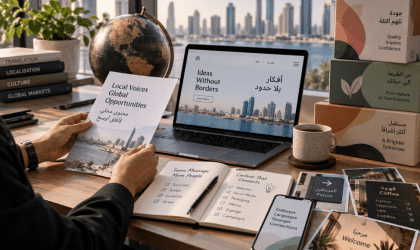

The UAE is home to businesses, residents and customers from around the world. For translation and localisation companies, that multilingual environment creates opportunities across corporate communications, websites, e-commerce, marketing, media, technology and other sectors.
A modern language business can also go far beyond translating documents. You might localise websites and apps, adapt marketing campaigns for Arabic-speaking audiences, subtitle video content, manage multilingual content or provide language support to international companies entering the UAE and wider Middle East.
If you want to turn those skills into a business, setting up in a UAE free zone can provide a practical route to establishing your company.
The key is choosing the right licensed activity for what you actually intend to offer. This is particularly important because general commercial translation and certain types of official or legal translation should not automatically be treated as the same service.
Is a UAE Free Zone Right for This Business?
For many translation and localisation businesses, a free zone structure can be a good fit, especially when the company provides services digitally or works with clients across different markets.
A translation business may operate with a relatively lean structure. You could start as an individual entrepreneur, build a small in-house team, or work with a network of translators, editors, proofreaders, voice artists and localisation specialists.
A free zone setup can work particularly well for businesses providing services such as:
- Business and commercial translation
- Website and e-commerce localisation
- Software and app localisation
- Marketing localisation and transcreation
- Subtitling and captioning
- Multilingual content adaptation
- Editing and proofreading
- Language-related content services
- Localisation project management
The model is also suitable for companies serving international clients remotely. Your translators or specialist partners do not necessarily need to sit in one traditional office for every project.
Before setting up, however, think about the type of documents you plan to translate. If your business intends to provide legal or certified translation for official use, additional requirements or approvals may apply depending on the service. Confirm the exact activity and approval requirements before advertising those services.
The Licence and Activities You Need
Your business licence should reflect the services your company actually provides. Under Shams regulations, a licensee must only carry out activities permitted on its valid licence. (Shams)
That distinction matters for a translation and localisation company because the industry now includes several different types of work.
For example, imagine two businesses.
The first translates product descriptions, marketing campaigns and websites from English into Arabic for international brands. The second translates documents intended for submission to courts or government authorities.
Both work with languages, but their regulatory requirements may not necessarily be identical.
When applying, describe your business model clearly. Tell the Shams team whether you plan to provide translation, localisation, content adaptation, subtitling or related services so the appropriate activities can be identified.
Shams offers a wide range of business activities and allows multiple activities under one licence, subject to the applicable package and activity combination. This can be useful if your company plans to combine language services with compatible activities such as content or media services. (Start With)
Also remember that some business activities can require external approval from the relevant competent authority before operations begin. (SMC Docs)
How to Set Up, Step by Step

Starting a translation and localisation company does not require building a large agency from day one. A specialist translator with a strong client base can begin with a focused service and expand as demand grows.
A typical setup process looks like this:
1. Define Your Services
Decide what you are actually selling. Translation is only one possibility. You may specialise in Arabic localisation, multilingual websites, e-commerce content, subtitles, marketing transcreation or another niche.
2. Identify Your Target Clients
A translation company serving law firms may have very different requirements from one localising websites for technology companies. Knowing your market helps you select the right activities from the beginning.
3. Choose Your Business Activities
Match your intended services to the activities available through Shams. Do not simply select a broad activity because it sounds close to what you do.
4. Choose Your Company Structure and Package
Consider your number of shareholders, expected visa requirements, activities and workspace needs. These choices can affect the overall setup cost.
5. Submit the Required Documents
Complete your application and provide the required shareholder and company information.
6. Make the Required Payment
Once your application and package have been confirmed, complete the applicable payment.
7. Receive Your Business Licence
Shams provides a digital setup process designed to keep company formation straightforward. Its current setup process starts with selecting the licence and business activity, followed by submitting the required documents and payment before the licence is issued. (Start With)
Once established, you can move on to the operational side of the business, including building your website, creating translation workflows, recruiting language specialists and approaching clients.
Cost
One advantage of a translation or localisation company is that the initial operating model can be relatively lean. You may not need expensive equipment, inventory or a large physical premises to begin serving clients.
Your company setup cost, however, depends on factors such as the licence package, selected activities, number of shareholders, visa requirements and workspace or additional services.
Shams currently offers company setup options starting from AED 5,750, with different packages available depending on the business requirements. (Start With)
When budgeting, think beyond the licence itself. A growing translation agency may also need to budget for visas, banking, accounting, professional software, website development, translation-management tools and specialist freelancers.
The best approach is to build your setup around what you need now rather than paying for a structure designed for a much larger company before you have the client volume to support it.
Visas for You and Your Team
Your visa requirements will depend heavily on how you build the business.
A solo translator may only need an investor or owner visa. A growing agency might eventually require residence visas for project managers, translators, editors, sales staff or other employees.
Shams offers packages with visa options, allowing businesses to choose a setup that better reflects their staffing requirements. (Start With)
Translation businesses can also use a hybrid staffing model. For example, you might employ a localisation project manager and Arabic editor directly while using external specialists for less frequently requested languages.
That flexibility can help control overhead while you build recurring client demand.
If you expect to hire employees, discuss your intended team size when selecting your Shams package rather than treating visas as an afterthought.
How Shams Sets You Up
For a translation and localisation entrepreneur, getting the company structure right is more useful than simply getting a licence quickly.
Shams can help you identify business activities that match the services you intend to provide, select an appropriate setup package and complete the company formation process online.
The ability to combine multiple compatible business activities can also be useful as the company evolves. A founder might begin with translation and localisation, for example, before adding compatible content or media-related services as client demand develops.
Shams company setup options currently start from AED 5,750, helping founders establish a professional UAE business without automatically committing to the cost structure of a large traditional agency. (Start With)
Speed can also matter when you already have a contract waiting or a client asking for company documents. Shams has previously offered business licence issuance in as little as 60 minutes through qualifying setup initiatives. Availability and conditions should be confirmed with the Shams team when applying. (Shams)
For language entrepreneurs, the bigger opportunity is what happens after setup. A UAE translation business can start with one language pair or specialist service and gradually develop into a broader localisation company serving businesses across multiple countries.
FAQs
Do I need a licence to start a translation business in the UAE?
Yes. If you establish and operate a business through Shams, you need a valid licence covering the activities the company carries out. Shams regulations state that a licensee should only perform activities permitted under its valid licence. (Shams)
Can I start a translation company as one person?
Yes, a translation or localisation business can begin with a lean structure. You can establish the company and expand your team or network of specialists as your client base grows.
Can I offer both translation and localisation?
Potentially, yes. The important point is to select activities that accurately cover the services you intend to provide. Discuss your full business model with Shams before completing the licence application.
Is localisation different from translation?
Yes. Translation generally focuses on converting content from one language into another. Localisation goes further by adapting content for a particular market, which can include terminology, cultural references, tone, imagery, layouts, currencies and other market-specific details.
Can my company translate websites and apps?
A language-services business may specialise in website, software and app localisation, provided its licensed activities cover the services being offered. Confirm the appropriate activity combination during setup.
Can I provide legal or certified translation?
Do not assume that a general translation or language-services licence automatically authorises every form of legal or certified translation. Services involving documents for official or legal use may be subject to additional requirements or approvals. Confirm the applicable activity and regulatory requirements before offering such services.
How much does it cost to start through Shams?
Shams currently offers company setup options starting from AED 5,750. Your actual cost depends on factors such as your package, activities, visas, shareholders and any additional services required. (Start With)
Can I hire translators under my company?
You can build a team as the business grows, subject to the visa allocation and employment requirements applicable to your setup. Shams offers licence packages with visa options for businesses that need UAE residence visas. (Start With)
Can I work with clients outside the UAE?
Translation and localisation are naturally international services, and many agencies serve clients across multiple countries. Your contracts, banking arrangements, tax position and any market-specific requirements should still be considered based on where and how you conduct business.
Can I add more services later?
Potentially, yes. Shams supports a wide range of business activities, and compatible activities can be available under the same licence. Check with Shams before adding a new service to ensure it is covered by your licensed activities. (Start With)
