


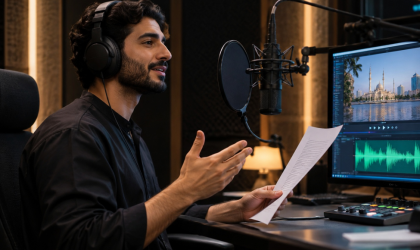

You do not need a large recording studio or a team of professional voice actors to start a voiceover business in the UAE. With the right business licence, recording equipment and client strategy, you can build a professional audio business from a home recording booth, shared studio or dedicated production facility.
The first step is choosing a licence that covers the services you intend to provide.
A solo voice artist recording advertisements and corporate narrations has different business requirements from a dubbing company employing actors, sound engineers and translators. Some projects may also involve media approvals, particularly when the finished content is intended for public broadcasting or regulated advertising.
For entrepreneurs considering a voice over business license in the UAE, understanding these differences can help avoid unnecessary expenses and licensing mistakes.
The opportunity extends beyond English-language advertising. Arabic dubbing, multilingual localisation, e-learning narration, gaming and corporate communications all offer potential markets for voice professionals.
This guide explains how to establish a voiceover and dubbing business in the UAE, choose the appropriate licence, understand media regulations and build a sustainable business through Shams Free Zone.
Freelance Permit or Company: Choosing Your Route
One of the first decisions is whether to operate independently or establish a registered company.
Both routes can be suitable, depending on your services, clients and growth plans.
Freelance Permit for Independent Voice Artists
A freelance permit may suit professionals who provide voice services personally without operating a larger production company.
Typical services include:
- Recording voiceovers for advertisements and promotional videos.
- Narrating audiobooks and educational material.
- Providing character voices for animation or games.
- Recording corporate presentations and training videos.
- Delivering audio files remotely to international clients.
The UAE recognises freelance work permits for qualifying independent professionals. However, eligibility and permitted activities depend on the issuing authority.
A freelance permit does not automatically authorise every type of media production or advertising activity.
Before applying, confirm that the permit specifically covers your intended voiceover services.
Company Licence for Voiceover and Dubbing Studios
A company licence is generally more suitable if you plan to offer several services, build a production team or contract directly with corporate clients.
For example, a dubbing business might coordinate script adaptation, translation, voice casting, recording, editing and final audio delivery.
Operating through a company can make it easier to organise these services under a commercial structure, subject to the approved activities.
| Consideration | Freelance permit | Company licence |
|---|---|---|
| Best suited for | Individual voice artists | Studios, agencies and production teams |
| Services | Personal voice services within permit scope | Multiple approved business activities |
| Hiring employees | Generally not the intended structure | Possible, subject to visa and employment approvals |
| Studio requirements | Often suitable for remote work | Home, shared or dedicated facilities, subject to approval |
| Growth potential | Primarily individual services | Suitable for expanding operations |
For voice artists testing the market, independent work may be a practical starting point. Entrepreneurs planning a multilingual dubbing agency or full-service audio production business may benefit from establishing a company from the beginning.
The Media Activity Behind Voice Work
A common mistake when starting an audio business is assuming that all voice-related services fall under one licensing activity.
In practice, voiceover recording, dubbing, sound production and advertising services can involve different business activities.
The correct classification depends on what the business actually delivers.
For example:
Voiceover recording: Recording spoken narration for advertisements, presentations, documentaries and digital content.
Dubbing and localisation: Replacing original dialogue with recorded dialogue in another language, often involving translation, timing and audio editing.
Audio production: Recording, editing, mixing and mastering sound for commercial or creative projects.
Advertising production: Producing audio advertisements or promotional material for brands and agencies.
Sound recording studio services: Operating recording facilities and providing technical recording services.
These descriptions explain potential business models. They should not be treated as confirmed official Shams activity names or codes.
An entrepreneur offering both voiceover recording and audio post-production should confirm whether both services are covered by the selected activity or whether additional activities are required.
Similarly, a business that produces advertising content may have different obligations from a studio that simply records audio supplied by a client.
Choosing the right activity from the beginning helps prevent restrictions when expanding services or signing larger production contracts.
Does Voice Work Need a Media Council Permit?
Not every voiceover recording requires a separate UAE Media Council permit.
The important distinction is between operating a licensed audio business, producing media content and publishing or distributing regulated material.
A business licence establishes the commercial activity. Additional media permits or approvals may apply depending on the content, distribution channel and role of the business.
Recording Commercial Voiceovers
Consider a voice artist hired by an advertising agency to narrate a promotional video.
The artist records the script, edits the audio and delivers the finished file to the agency. The agency then incorporates the recording into an advertisement.
This arrangement is different from the voice artist independently publishing advertising content through a personal social media account.
The recording service itself should not automatically be treated as requiring an individual social media Advertiser Permit. However, the wider advertising production or publication may be subject to media regulations and content standards.
Advertising and Social Media Content
The UAE Media Council operates an Advertiser Permit framework covering specified advertising activities on social media and digital platforms.
A voice artist who personally publishes promotional content may have obligations different from those of a studio supplying recorded audio to another business.
For example:
- A voice artist delivering narration files to an agency is providing a production service.
- A creator publishing sponsored promotional videos through their own account may fall within the Advertiser Permit framework.
- A production company distributing advertisements or operating a regulated media service may need additional approvals based on its activities.
The distinction matters because a commercial recording contract does not automatically create the same permit obligations as publishing sponsored content.
The UAE Media Council’s Advertiser Guide also addresses advertising standards and additional approvals for certain regulated sectors, including healthcare, finance and real estate.
Broadcasting, Films and Other Media Productions

Additional permissions may be relevant when producing or distributing content for television, radio, cinema or other regulated media channels.
A dubbing studio working on a film, for example, should clarify whether it is only supplying post-production services or is also responsible for distributing the finished work.
Before accepting projects involving broadcasting, public advertising or regulated media distribution, confirm the applicable requirements with the UAE Media Council and the relevant licensing authority.
A Shams business licence should not be presented as a substitute for any separately required media approval.
Studio, Home Booth or Rented Facilities
A professional voiceover business does not necessarily require a purpose-built recording studio.
Many commercial recordings can be completed using a properly treated home booth and reliable audio equipment.
The right setup depends on your recording volume, client expectations and the type of work you deliver.
Option 1: Home Recording Booth
A home recording booth is often suitable for independent voice artists, audiobook narrators and remote freelancers.
A basic professional setup may include a quality microphone, audio interface, headphones, acoustic treatment, recording software and a quiet recording environment.
Acoustic treatment is particularly important. A more expensive microphone cannot compensate for excessive room echo, traffic noise or poor recording conditions.
Working from home must still comply with the conditions of your business licence, property rules and any applicable residential-use restrictions.
Option 2: Renting a Recording Studio
Studio rental offers a flexible alternative for entrepreneurs who do not want to invest heavily in equipment.
It may be especially useful for:
- Projects involving several voice actors.
- Advertising campaigns requiring supervised recording sessions.
- Arabic dubbing projects requiring dialogue direction.
- High-end commercial productions.
- Projects involving clients who want to attend recording sessions.
Instead of paying for a permanent studio, you can book facilities when projects require them.
Option 3: Establishing a Dedicated Studio
A dedicated studio may become worthwhile when your business has regular production work and several clients.
A larger facility can support separate recording rooms, editing suites and collaborative sessions.
However, the initial investment extends beyond microphones and computers. You may need sound insulation, ventilation, appropriate premises, technical equipment and additional property-related approvals.
| Setup option | Initial investment | Suitable for |
|---|---|---|
| Home recording booth | Relatively low | Freelancers and remote narration |
| Rented recording studio | Project-based | Small agencies and occasional large projects |
| Dedicated studio | Higher | Established dubbing and audio production businesses |
A sensible approach is to begin with a smaller setup, validate demand and invest in permanent facilities once recurring revenue supports the expense.
The Arabic Dubbing and Localisation Opportunity
One of the most interesting opportunities for UAE audio entrepreneurs is multilingual dubbing and localisation.
International businesses increasingly need content that communicates naturally with different audiences. For companies serving the Middle East, this can mean adapting English-language material into Arabic.
However, localisation is more than translating a script word for word.
A successful dubbing project considers pronunciation, regional vocabulary, cultural references, timing and the tone of the original performance.
Modern Standard Arabic and Regional Dialects
A dubbing studio can differentiate its services by offering multiple Arabic language options.
Modern Standard Arabic (MSA) is commonly used for formal educational, corporate and informational content intended for broad Arabic-speaking audiences.
Gulf Arabic can be appropriate for advertising and conversational content targeting audiences in the UAE and neighbouring Gulf markets.
Egyptian Arabic may suit entertainment, character-driven content and campaigns targeting Egyptian-speaking audiences.
Other dialects may be relevant depending on the target market.
Rather than offering generic Arabic dubbing, businesses can position themselves around specific audiences and content categories.
Where the Opportunity Exists
E-learning and corporate training. Companies operating across several countries often need training videos, onboarding materials and educational modules in different languages.
Animation and entertainment. Animated content, documentaries and digital entertainment can require translation, voice casting, recording and audio synchronisation.
Gaming and interactive media. Video games and interactive experiences may require character dialogue, tutorials, interface narration and multilingual audio assets.
Advertising and branded content. Brands serving UAE and regional audiences may require Arabic adaptations of international campaigns.
A studio based in Sharjah can position itself to serve UAE clients and international production companies seeking Arabic-language audio services.
The strongest competitive advantage is not simply offering Arabic recording. It is combining accurate translation, appropriate dialect selection, professional voice direction and reliable production quality.
Hiring Voice Talent: Contractor or Employee
As your business grows, you may need additional voice actors, translators, sound engineers and audio editors.
There are two common ways to build that production capacity.
Working With Independent Contractors
Independent voice artists can be useful when projects require different languages, accents or character voices.
For example, a dubbing company might work with a UAE-based Arabic voice actor for one project and an international English narrator for another.
This allows the business to access specialist talent without maintaining a large permanent team.
However, contractors must have the appropriate legal authorisation to perform the work.
A contractor agreement should also clearly establish:
- The scope of the recording.
- Payment terms and revision limits.
- Recording deadlines and technical specifications.
- Confidentiality obligations.
- Commercial usage rights and any restrictions on reuse.
- Whether synthetic voice replication or AI training is permitted.
The last point is increasingly important. A client receiving a recording should not assume it has unrestricted rights to clone the actor’s voice or use it to train an AI system.
Hiring Employees
A studio with regular production work may prefer to employ sound engineers, production coordinators or full-time voice artists.
Under Federal Decree-Law No. 33 of 2021, employment relationships in the UAE are subject to work authorisation requirements. The UAE also provides permit categories for part-time and freelance work, subject to their conditions.
For a free zone business, the relevant free zone employment and immigration procedures must also be considered.
A person holding a UAE residence visa is not automatically authorised to work for every company.
Before engaging talent, confirm their work authorisation and whether the relationship is genuinely independent contracting or employment.
For many new dubbing businesses, a small permanent production team supported by properly authorised freelance voice talent can offer flexibility.
Client Niches: Advertising, IVR, E-Learning and Film
A voiceover business can serve several industries, but specialising in a few services often makes it easier to build a recognisable portfolio and attract repeat clients.
Advertising and Brand Campaigns
Advertising agencies regularly require professional narration for video advertisements, radio commercials, social media campaigns and product demonstrations.
Voice artists can work directly with brands or become recurring suppliers to creative agencies.
Commercial projects may also command different fees depending on where and how long the recording will be used.
For example, a voiceover used in a short internal company presentation should not necessarily be priced the same as a recording used in a regional advertising campaign.
IVR and Corporate Telephone Systems
Interactive Voice Response (IVR) systems use recorded messages to guide callers through telephone menus.
Banks, healthcare providers, hotels, customer service centres and other businesses may require professionally recorded telephone prompts.
These projects can involve multilingual recording, particularly Arabic and English.
IVR services may also create opportunities for ongoing work when companies update menus, opening hours or customer service messages.
E-Learning and Corporate Training
Educational institutions, training providers and corporate learning teams use narration to make digital learning materials more engaging.
Typical projects include employee onboarding, safety training, software tutorials and professional development courses.
For businesses offering Arabic and English narration, e-learning can be an attractive niche because large training programmes often contain several modules.
Film, Animation and Gaming
Film and entertainment projects can involve character voice acting, dialogue replacement, dubbing and narration.
Unlike straightforward corporate voiceovers, these projects may require voice direction, character consistency, script adaptation and close coordination with production teams.
A dubbing company that can manage these requirements may be able to establish longer-term relationships with animation studios, game developers and content distributors.
How to Set Up a Voiceover Business in the UAE, Step by Step
Starting a voiceover or dubbing business becomes easier when you separate licensing decisions from production and commercial planning.
Step 1: Define Your Services
Start by identifying exactly what your business will provide.
Will you record voiceovers personally, operate a dubbing studio, produce audio advertisements or manage multilingual voice talent?
Your answer determines which business activities you should investigate.
For example, a solo narrator may require a simpler structure than a company providing translation, dubbing and audio post-production.
Step 2: Choose Your Business Structure
Decide whether a freelance permit or company licence best suits your plans.
If you expect to hire employees, operate under a studio brand or offer several services, a company structure may be more appropriate.
Step 3: Select Your Business Activities
Review the available licensing activities with your chosen authority.
If you are establishing a business through Shams Free Zone, explain your complete service model so the appropriate activities can be identified.
Shams’ Companies and Licensing Regulations 2024 require businesses to operate within the activities permitted by their valid licences.
Step 4: Confirm Additional Media Requirements
Determine whether your services involve regulated media production, advertising publication, broadcasting or other activities requiring separate approvals.
Federal Decree-Law No. 55 of 2023 concerning Media Regulation establishes a framework for media activities, including electronic and digital media. Article 12 addresses licensing and permits for certain digital media and advertising activities.
For recorded commercial audio, the precise obligations depend on the activity and how the content is used.
Step 5: Register Your Business
Once the activities and structure are confirmed, complete the business registration process.
This generally involves selecting a business name, submitting the required documents, choosing a licence package and paying the applicable fees.
The licensing authority may request additional information depending on your activities.
Step 6: Arrange Your Recording Facilities
Choose a home recording booth, rented studio or dedicated facility.
Consider your technical requirements, production volume and available budget.
Avoid investing in expensive premises before establishing a reliable client base.
Step 7: Build Your Portfolio
Prepare professional voice samples demonstrating your range.
A useful starter portfolio could include an English corporate narration, an Arabic advertisement, an IVR recording and a short character performance.
If you provide dubbing services, include examples demonstrating synchronisation, translation quality and voice direction.
Only use scripts and recordings you have permission to publish.
Step 8: Launch and Find Clients
Create a professional website showcasing your services, recording samples and contact details.
You can approach advertising agencies, video production companies, e-learning providers, game developers and international localisation agencies.
Clear service packages, professional contracts and reliable delivery times can help establish long-term relationships.
Documents, Banking and Rates
Once your business model is established, the next priorities are registration documents, payment arrangements and a sustainable pricing structure.
Documents Required for Business Setup
The exact documents depend on your licensing authority, legal structure and shareholder circumstances.
Common requirements may include:
- Passport copies of shareholders.
- UAE residence visa or Emirates ID details, where applicable.
- Proposed business name.
- Selected business activities.
- Shareholder and company registration information.
- Additional approvals or supporting documents where required.
A business with several shareholders or specialised media activities may have additional requirements.
Opening a Business Bank Account
A dedicated business bank account helps separate commercial income from personal finances.
This is particularly useful when working with corporate clients or receiving international payments.
Banks may request your trade licence, incorporation documents, ownership information, identification documents and evidence of business activity.
For a new voiceover company, a website, portfolio, client contracts and invoices may help explain the nature of the business.
Account approval remains subject to the bank’s compliance and due diligence requirements.
How Much Should You Charge for Voiceover Work?
There is no single standard rate for every voiceover project.
Pricing depends on factors such as the recording length, language, commercial usage, complexity and turnaround time.
Common pricing models include:
| Pricing model | Suitable projects |
|---|---|
| Per finished minute | E-learning, audiobooks and narration |
| Per word | Corporate scripts and straightforward narration |
| Per project | Advertising and branded content |
| Per recording session | Dubbing, animation and character recording |
| Project fee plus usage rights | Commercial campaigns with defined distribution |
For example, a 30-second advertisement may require less recording time than a 20-minute training module, but its commercial usage rights may justify a higher fee.
Dubbing projects should also account for translation, script adaptation, voice casting, direction, editing and quality assurance.
A practical pricing principle: Separate the recording fee from additional production services and commercial usage rights.
This makes quotations more transparent and reduces disagreements over revisions or extended campaign use.
Understanding Business Costs
The total cost of starting a voiceover business can include licensing, visas, equipment, studio rental, software and ongoing operating expenses.
Shams currently advertises business setup options starting from AED 5,750, including a media package at that starting price. However, this is a general package price, not a confirmed quote for a voiceover or dubbing activity. The final amount depends on the selected activities, licence term, visa requirements and other services.
VAT and Tax Considerations
Voiceover and dubbing companies must also consider their tax obligations.
Under the UAE VAT framework, the standard VAT rate is 5% for applicable taxable supplies.
The Federal Tax Authority specifies a mandatory VAT registration threshold of AED 375,000 in taxable supplies and imports, measured under the relevant 12-month or forward-looking rules.
Voluntary registration may be available at AED 187,500, subject to the applicable conditions.
Corporate Tax obligations must be assessed separately. Establishing a business in a free zone does not automatically exempt all its income from Corporate Tax.
Businesses should confirm their registration, filing and tax obligations with the Federal Tax Authority or a qualified tax advisor.
Licensing Voice Work Through Shams Free Zone
For entrepreneurs entering the UAE’s creative economy, Sharjah Media City (Shams) offers a business setup environment focused on media, content creation and entrepreneurship.
A voiceover business can benefit from a licensing structure that supports its commercial operations while allowing the founder to concentrate on building a client portfolio.
A Media-Focused Business Environment
Shams is based in Sharjah and supports businesses across creative and commercial sectors.
For voice artists, audio producers and dubbing entrepreneurs, this provides an opportunity to establish a UAE company within a media-oriented business environment.
Shams offers a range of business activities, with the ability to combine eligible activities under one licence, subject to package conditions and approval.
This can be useful for entrepreneurs who plan to expand from voiceover recording into complementary services such as audio production or localisation.
The exact activity names and combinations should be confirmed with Shams before applying.
Flexible Business Setup Options
A voiceover entrepreneur may not need a large commercial office during the early stages of the business.
Shams offers business setup packages and workspace options that can accommodate different operating requirements.
For businesses requiring professional recording facilities, Shams also advertises podcast and content production facilities. Availability, suitability and booking terms should be confirmed separately. Its larger Shams Studios development is currently listed as coming by 2028, rather than being an existing facility available for immediate use.
Company Ownership and Visa Options
Shams permits 100% foreign ownership for eligible company structures.
Entrepreneurs can also explore residence visa options based on their selected package and business requirements.
Visa allocations, eligibility and associated costs should be confirmed during the application process.
Building an Audio Business From Sharjah
Sharjah offers a useful base for entrepreneurs who want to serve clients across the UAE while building a regional or international audio production business.
A voiceover company does not necessarily need to be located in the same city as every client.
Many recordings can be delivered remotely, allowing businesses to work with advertising agencies, production companies and corporate clients in different markets.
For an Arabic dubbing company, this creates opportunities to serve international clients looking for regional language expertise.
Shams can support the company formation process, while the business builds its own production network, client relationships and specialist capabilities.
Ready to turn your voiceover skills into a business?
Explore business licensing options with Shams Free Zone and find a setup that matches your voiceover, dubbing or audio production plans.
You can also use the Shams Cost Calculator to explore potential business setup costs based on your requirements.
Frequently Asked Questions
Can I Do Voiceover Work on a Freelance Permit?
Yes, potentially. Independent voice artists may be able to provide voiceover services under an appropriate freelance permit. However, the permit must cover the intended activity, and the individual must satisfy the issuing authority’s conditions. A freelance permit does not automatically authorise all advertising, broadcasting or dubbing activities.
Do I Need a Media Licence in the UAE?
You need an appropriate business licence or other valid authorisation to provide commercial voiceover services. Whether a media-related activity is required depends on the services you offer. Recording narration, operating a dubbing studio and publishing advertising content may involve different licensing requirements.
Can I Work From Home Without a Studio?
Yes, home-based recording may be possible where your licence conditions, premises rules and applicable local requirements allow it. Many voice artists use acoustically treated home booths to record narration, e-learning material and advertisements. You should confirm that your specific setup and location are permitted before operating.
Do I Need Media Council Approval?
Not necessarily for every recording project. Requirements depend on the activity, content and distribution method. The UAE Media Council’s Advertiser Permit framework applies to specified advertising activity on social media and modern technological platforms. A voice artist supplying audio files to a client is not automatically in the same position as an individual publishing sponsored content. Additional approvals may apply to regulated media activities.
Which Free Zone Suits Voice and Audio Work?
A free zone that supports relevant media and audio production activities may be suitable. Shams Free Zone is an option for entrepreneurs seeking a Sharjah-based company with access to media-oriented business licensing. Before applying, confirm that the available activities cover voiceover, dubbing or audio production as required.
