


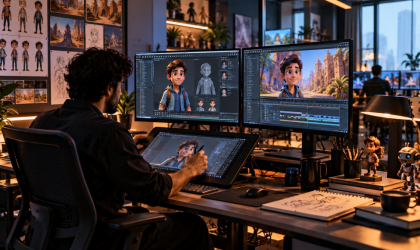

Animation is no longer limited to cartoons and entertainment. Today, businesses use animation to explain products, market properties, develop video games, create virtual experiences and bring advertising campaigns to life.
For creative professionals, this creates an opportunity to build an animation studio in the UAE, whether as an independent motion designer, a small 2D production team or a full-service 3D animation company.
The UAE offers access to advertising agencies, property developers, technology companies and international brands that regularly commission visual content. With the right business licence, software and production workflow, an animation studio can serve clients locally and internationally.
However, starting an animation business involves more than purchasing creative software. You need to select the appropriate licensed activities, decide whether to establish a mainland or free zone company, and understand how different animation services fit within your business scope.
This guide explains how to start an animation business in the UAE, including licensing, studio equipment, staffing, pricing and the advantages of establishing your company through Shams Free Zone in Sharjah.
Where the Work Is: Advertising, Real Estate, Gaming and VR
One of the first decisions when starting an animation studio is choosing the market you want to serve.
Animation covers several industries, each with different client expectations, production requirements and revenue opportunities.
Advertising and Branded Content
Advertising is one of the most accessible markets for new animation studios.
Businesses regularly commission animated content for social media campaigns, digital advertisements, product launches and promotional videos.
Common services include animated logos, explainer videos, product demonstrations, character animation and motion graphics for social media.
A small studio can begin with relatively modest equipment and expand its production capabilities as demand increases.
Real Estate and Architectural Visualisation
Real estate developers and architectural firms use 3D animation to present projects before construction is completed.
Services can include architectural walkthroughs, property flythroughs, interior visualisations and animated presentations of master plans.
This market often requires advanced 3D modelling, realistic lighting, rendering and collaboration with architects or property marketing teams.
For studios specialising in architectural animation, the ability to produce accurate, high-quality visualisations can become an important competitive advantage.
Gaming and Interactive Entertainment
Game developers need animated characters, environments, cinematic sequences and visual effects.
An animation studio can provide outsourced production services to gaming companies without developing its own games.
Typical projects include character rigging, gameplay animations, 3D assets, cinematic trailers and environment animation.
However, producing animation assets for a game is not necessarily the same licensed activity as developing, publishing or distributing the game itself. Studios planning to offer both services should ensure their business activities cover the intended operations.
Virtual Reality and Augmented Reality
Virtual reality (VR) and augmented reality (AR) create additional opportunities for animation businesses.
Companies use immersive experiences for property demonstrations, training simulations, exhibitions, tourism and product presentations.
Animation studios can develop 3D assets, interactive environments and visual content for these applications.
Studios offering complete VR or AR software development may need additional licensed activities beyond animation production.
The important starting point is to choose a service that matches your existing skills and equipment. A studio can expand into other markets once it has established a portfolio and reliable production process.
The Licence and Activity Codes for Animation
To operate an animation studio commercially in the UAE, you need a business licence that covers the services you intend to provide.
The correct activity depends on what your studio actually produces.
For example, a company creating animated advertising videos may require a different activity scope from one developing interactive gaming software or producing full-length animated films.
Depending on the licensing authority, relevant activities may fall within categories such as:
- Animation and audiovisual production
- Motion graphics and creative design
- Film and video production
- Graphic design services
- Digital media production
- Computer graphics and related creative services
These are descriptions of potential business activities, not confirmed official Shams activity names or codes. The exact activity classification must be checked against the current Shams approved activity list before submitting an application.
Why the Activity Code Matters
Your licensed activities determine the services your company is authorised to provide.
For example, a studio licensed only for graphic design should not automatically assume that its licence covers film production, software development or every form of audiovisual content creation.
Similarly, creating 3D models for advertising is different from operating a game publishing business.
When choosing activities, consider your complete service offering rather than just the first project you intend to deliver.
A studio might initially focus on motion graphics but later offer animated product videos, 3D modelling and post-production services.
Selecting compatible activities from the beginning can reduce the need for future licence amendments.
Shams Free Zone offers business licensing for a broad range of creative and media-related activities. Entrepreneurs can discuss their intended services with the Shams team to identify the appropriate activity combinations.
Some media content, broadcasting, filming or distribution activities may also require separate regulatory permissions. A company licence does not automatically replace those approvals.
2D, 3D and Motion Graphics: Scoping Your Activities

Although animation is often treated as a single industry, different production services involve different workflows and business requirements.
Understanding these distinctions helps entrepreneurs select the right licence scope and avoid investing in unnecessary equipment.
| Animation service | Typical projects | Main requirements |
|---|---|---|
| 2D animation | Explainer videos, educational content, character animation | Illustration, storyboarding and animation software |
| 3D animation | Product videos, architectural walkthroughs, character animation | 3D modelling, lighting, rendering and powerful workstations |
| Motion graphics | Social media ads, animated typography, brand videos | Graphic design, compositing and video editing |
| Visual effects (VFX) | CGI integration, compositing, digital environments | Tracking, simulation, compositing and rendering |
| Interactive animation | Gaming assets, VR and AR experiences | Real-time engines, 3D assets and technical development |
2D Animation
A 2D animation studio creates movement using illustrations, characters, graphics and layered digital artwork.
This approach works particularly well for educational videos, animated advertisements and brand storytelling.
A small team can manage much of the production process using digital illustration and animation tools.
3D Animation
3D animation involves creating and animating objects or characters in three-dimensional digital environments.
It is widely used in architectural visualisation, product advertising, gaming and entertainment.
Production usually involves modelling, texturing, rigging, lighting, animation and rendering.
Because 3D projects can be computationally demanding, equipment and rendering costs may be higher than those of a basic 2D studio.
Motion Graphics
Motion graphics focuses on animated design elements, including typography, icons, illustrations, logos and visual transitions.
It is particularly relevant to advertising agencies, corporate communications teams and social media content producers.
For entrepreneurs starting independently, motion graphics can offer a practical entry point because many projects can be completed without a large production team.
Do You Need Separate Licences for Each Animation Style?
Not necessarily.
A single appropriately selected licensed activity, or a combination of compatible activities, may cover several animation services.
The deciding factor is the official activity description and its permitted scope, rather than the software or artistic technique used.
For example, creating a 3D product animation and developing an interactive VR application may require different activity classifications even when both involve the same 3D assets.
Before applying, prepare a clear list of the services your studio intends to sell and confirm their coverage with the licensing authority.
Free Zone vs Mainland Structures
Animation entrepreneurs in the UAE can generally choose between establishing a mainland company or registering through a free zone.
Both structures can support creative businesses, but the most suitable option depends on your clients, workspace requirements and planned operations.
Mainland Company Setup
A mainland company may be suitable for animation businesses that need a physical studio in a particular emirate or intend to conduct activities requiring mainland premises or approvals.
Depending on the selected activity and legal structure, mainland companies can also offer full foreign ownership.
However, premises requirements, licence fees and regulatory procedures vary by emirate and activity.
Free Zone Company Setup
A free zone structure can be particularly attractive for animation studios operating through digital production workflows.
Many animation businesses do not need a large physical office during their early stages. Artists can create, review and deliver projects digitally while collaborating with clients remotely.
Advantages of a suitable free zone setup can include:
- 100% foreign ownership
- Business licensing for eligible creative activities
- Flexible workspace options, depending on the package
- Access to UAE residency visa services
- The ability to contract with international clients
- A straightforward company formation process
A free zone company can generally provide services to clients outside the free zone, subject to the applicable activity, jurisdictional and regulatory rules. Certain onshore operations may require additional permissions or arrangements.
Why Consider Sharjah?
Dubai is frequently associated with the UAE’s creative industries, but it is not the only location for establishing an animation business.
Sharjah offers another option for entrepreneurs who want a UAE company base without automatically committing to a Dubai office.
Shams Free Zone, officially Sharjah Media City (Shams), supports entrepreneurs across media, creative and other eligible business activities.
For animation studios delivering most of their work digitally, a Sharjah-based business licence can provide a practical foundation while allowing the company to build relationships with clients across the UAE and abroad.
The Studio Stack: Software, Workstations and Rendering
The equipment needed to start an animation studio depends on the type of projects you plan to produce.
A solo motion graphics designer may only need a powerful computer and a few software subscriptions. A 3D production studio working on complex environments may require multiple workstations, shared storage and rendering infrastructure.
Essential Animation Software
Common tools include:
| Software | Primary use |
|---|---|
| Adobe After Effects | Motion graphics, compositing and visual effects |
| Adobe Animate | 2D animation and interactive content |
| Toon Boom Harmony | Professional 2D character animation |
| Blender | 3D modelling, animation and rendering |
| Autodesk Maya | Character animation, rigging and 3D production |
| Cinema 4D | Motion design and 3D graphics |
| Unreal Engine | Real-time environments and interactive visualisation |
| DaVinci Resolve | Video editing, colour grading and post-production |
You do not need every application from the beginning.
Choose software based on your production specialisation, client requirements and the formats you need to deliver.
Workstations and Hardware
For motion graphics and 3D animation, workstation performance can directly affect production speed.
Important considerations include processor performance, graphics processing capability, memory, storage speed and monitor accuracy.
A practical setup may include a computer with a dedicated graphics card, sufficient RAM, fast SSD storage, a colour-accurate monitor and reliable backup systems.
Complex simulations, high-resolution renders and large 3D scenes may require significantly more powerful hardware.
Rendering Infrastructure
Rendering converts animation scenes into finished images or video frames.
For smaller projects, rendering can be handled directly on a workstation.
Larger productions may benefit from cloud rendering services or dedicated render machines.
Cloud rendering can help studios handle demanding projects without immediately purchasing additional hardware. However, recurring rendering charges should be included in project quotations.
Storage and Collaboration
Animation projects often involve large files, multiple revisions and several creative contributors.
A reliable production workflow should include secure file storage, automated backups, version control, project management tools and a clear client approval process.
For studios working with international clients, secure file sharing and organised feedback systems can be just as important as the animation software itself.
Building a Team or Staying Solo
An animation business does not necessarily require a large team at launch.
Many successful studios begin with one or two creative professionals and expand as their project pipeline develops.
Starting as a Solo Animator
Independent animators can offer services such as logo animation, explainer videos, social media motion graphics, 3D product visualisation and animated presentations.
A solo operation generally has lower overheads and greater flexibility.
However, the founder must also manage client communication, quotations, revisions, project delivery and business administration.
Building a Small Production Team
As projects become more complex, a studio may need specialists such as:
- Creative director or animation director
- Storyboard artist and illustrator
- 2D or 3D animator
- 3D modeller and texture artist
- Motion graphics designer
- Video editor and compositor
- Producer or project manager
Not every role needs to be filled by a permanent employee.
A studio can work with freelance specialists and external production partners, provided the working arrangements comply with applicable UAE employment, immigration and contracting requirements.
When Should You Hire?
Hiring is usually more sustainable when the business has recurring clients or a consistent production pipeline.
For example, a studio delivering monthly animated advertising content may benefit from an in-house motion designer.
A business receiving occasional specialist 3D projects may find project-based collaboration more practical.
The objective is to build a team that matches actual client demand rather than increasing fixed costs too early.
How to Set Up, Step by Step
Starting an animation business in the UAE becomes easier when the process is divided into clear stages.
Step 1: Define Your Animation Services
Decide whether your studio will focus on 2D animation, 3D production, motion graphics, VFX or interactive experiences.
List the services you plan to invoice clients for, including any related production, design or post-production work.
Step 2: Choose Your Business Jurisdiction
Compare mainland and free zone options based on your activities, client requirements, workspace needs, visa plans and budget.
For a digitally operated animation studio, Shams Free Zone can be an option worth considering.
Step 3: Select Your Licensed Activities
Match your intended services with the approved activity descriptions available through the licensing authority.
Confirm whether additional activities are required for film production, software development, gaming or other specialised services.
Step 4: Choose a Company Name
Select a trade name that meets UAE naming requirements and reflects your creative business.
Check availability before proceeding with registration.
Step 5: Submit Your Application
Prepare the required identification and business information, then submit your company formation application.
Additional documentation or approvals may be required depending on the selected activities and ownership structure.
Step 6: Obtain Your Business Licence
Once the application is approved and the required fees are paid, the licensing authority can issue the company documents.
Shams offers a streamlined company formation process, with eligible business licences potentially issued in as little as 60 minutes once the applicable requirements are satisfied.
This does not mean every application, regulatory approval or residency visa will be completed within 60 minutes.
Step 7: Arrange Visas and Banking
If you plan to live and work in the UAE, select a setup package that supports your residency requirements.
You can also begin the process of applying for a corporate bank account using your company documents and supporting business information.
Bank account approval remains subject to the financial institution’s checks.
Step 8: Launch Your Studio
Once your company is properly licensed and any required additional approvals are in place, prepare your portfolio, establish your production workflow and begin approaching potential clients.
At this stage, clear service packages and professional contracts can help turn creative skills into a sustainable business.
Portfolio, Pricing and International Clients
A strong animation portfolio is often more persuasive than a long list of qualifications.
Clients want to see whether your studio can produce the visual style, quality and storytelling they need.
Building Your First Portfolio
If you are launching without an established client base, create a small selection of demonstration projects.
For example, a motion graphics studio could produce an animated brand advertisement, a 30-second explainer video and a product launch animation.
A 3D studio might showcase an architectural walkthrough, a realistic product render and a character animation.
Focus on demonstrating your strongest capabilities rather than displaying every animation technique.
Always obtain permission before including confidential client work in your portfolio.
How to Price Animation Services
Animation pricing depends on several factors, including production complexity, duration, visual style, revisions and delivery deadlines.
Studios commonly use three pricing models.
Project-based pricing: A fixed fee for a clearly defined deliverable, such as a 60-second explainer video.
Daily or hourly rates: Suitable for specialist animation work, revisions and outsourced production services.
Monthly retainers: Useful when advertising agencies or brands need recurring animated content.
For example, a studio producing monthly social media animations could offer a retainer covering an agreed number of videos, formats and revision rounds.
Before quoting a project, calculate the time required for concept development, storyboarding, asset creation, animation, rendering, sound and final delivery.
Your quotation should also explain how many revisions are included and what happens when a client requests additional work.
Working With International Clients
One advantage of an animation business is that most deliverables can be produced and transferred digitally.
A UAE-based studio can work with advertising agencies, game developers and production companies in different countries.
International contracts should clearly establish payment terms, delivery milestones, intellectual property ownership, permitted use of assets and cancellation conditions.
It is particularly important to clarify whether clients receive ownership of the final animation, editable project files, source models or only a licence to use the finished content.
For cross-border projects, businesses should also consider currency conversion, payment processing and applicable tax obligations.
Documents and Costs
The cost of starting an animation studio in the UAE depends on the selected licence, visa requirements, workspace and production equipment.
A solo motion graphics business may have significantly lower startup expenses than a studio producing high-end 3D animation.
Documents Required
For a typical individual shareholder application, documents may include:
- A valid passport copy
- UAE visa or Emirates ID details, if applicable
- Proposed company name
- Selected business activities
- Shareholder and contact information
- Additional supporting documents where required
Applications involving corporate shareholders or regulated activities may require further documentation.
Animation Studio Setup Costs
Your budget should account for both company formation and the resources needed to deliver client projects.
| Expense | What to consider |
|---|---|
| Business licence | Activity selection, company structure and renewal |
| Residency visas | Number of visas, immigration and related processing |
| Workspace | Flexible workspace or dedicated production premises |
| Software | Subscriptions, commercial licences and plugins |
| Equipment | Computers, graphics hardware and storage |
| Rendering | Cloud rendering credits or dedicated infrastructure |
| Website and portfolio | Domain, hosting and promotional materials |
| Operating expenses | Accounting, insurance, marketing and other overheads |
Shams offers company formation packages starting from AED 5,760, with the final cost depending on the selected package, activities and additional requirements. This starting figure should not be treated as a confirmed all-inclusive animation studio quotation.
A useful approach is to separate initial investment from monthly operating expenses.
For example, purchasing a workstation is generally an upfront investment, while software subscriptions, cloud rendering and storage services may create recurring costs.
You should also maintain sufficient working capital to cover expenses between client payments.
Taxes and Financial Obligations
Animation companies in the UAE should assess their corporate tax and VAT obligations.
UAE corporate tax generally applies at 9% to taxable income exceeding AED 375,000, subject to the applicable rules. Qualifying free zone persons may benefit from a 0% rate on qualifying income if all relevant conditions are satisfied.
VAT registration is generally mandatory once taxable supplies and imports exceed AED 375,000 over the applicable measurement period. Voluntary registration may be available at a lower threshold.
Free zone registration does not automatically exempt a company from these obligations.
Housing Your Studio Licence at Shams
An animation studio needs more than creative talent. It needs a legal business structure that supports client contracts, professional growth and the services it intends to provide.
Shams Free Zone provides a business setup option for entrepreneurs working in media, digital content and other creative industries.
Located in Sharjah, Shams offers a practical alternative for animation professionals who want to establish a UAE company without necessarily investing in a large production facility at launch.
Why Choose Shams for an Animation Business?
100% foreign ownership: International entrepreneurs can establish eligible companies without requiring a local shareholder.
Creative business activities: Shams supports media and creative businesses, with activity selection based on the services the company plans to offer.
Flexible setup options: Entrepreneurs can select company formation arrangements that reflect their operational and visa requirements.
Residency visa services: Eligible packages can support UAE residency applications for business owners and team members.
Streamlined registration: Shams offers an efficient licensing process, with eligible applications potentially benefiting from its 60-minute licence issuance service.
A Sharjah business base: Studios can establish their company in Sharjah while developing relationships with advertising, technology, property and entertainment clients across the UAE and internationally.
Whether you are an independent 2D animator, a motion graphics designer or an entrepreneur building a full-service 3D production company, the right licensing structure can help you establish a professional foundation.
The most important step is to match your intended animation services with the correct approved business activities.
With Shams, you can explore suitable licensing options, select your business structure and begin building your animation studio in the UAE.
Ready to turn your animation skills into a business?
Explore your company formation options with Shams Free Zone and take the first step towards launching your animation studio in the UAE.
Frequently Asked Questions
Do I need a media licence for animation in the UAE?
You need a valid business licence covering the animation services you intend to provide. Depending on your work, this may involve animation, design, audiovisual production or related creative activities. Certain regulated media operations, such as producing or distributing animated films, may require additional approvals from the relevant authorities.
Can freelancers get an animation licence in the UAE?
Yes. Individual animators can operate through an appropriate freelance permit or company licence, depending on the licensing authority and their requirements. For example, Dubai Media City includes animator among its eligible freelance activities. Independent animators can also explore suitable company formation options through Shams.
Which free zone suits an animation studio?
The best free zone depends on your animation specialisation, budget, visa requirements and workspace needs. Shams Free Zone in Sharjah is an option for creative entrepreneurs seeking a UAE business base. Other creative clusters, including those regulated by Abu Dhabi’s Creative Media Authority and Dubai Media City, may also be relevant depending on the services offered.
Can a UAE animation studio serve international clients?
Yes. A properly licensed UAE animation company can generally provide services to international clients, subject to its permitted activities and applicable laws. Studios should establish clear contracts covering deliverables, payments, intellectual property and cross-border tax considerations.
What does it cost to start an animation studio in the UAE?
Costs depend on the business licence, visa requirements, workspace, software and equipment. Shams has offered company formation packages starting from AED 5,760, but the actual price of an animation business setup depends on the current package eligibility and selected activities. High-end 3D studios may also need substantial investment in hardware and rendering.

